
Retractable Tonneau Cover Guide: What to Check Before You Buy
Updated July 2026 · Truck Cover Editorial Team
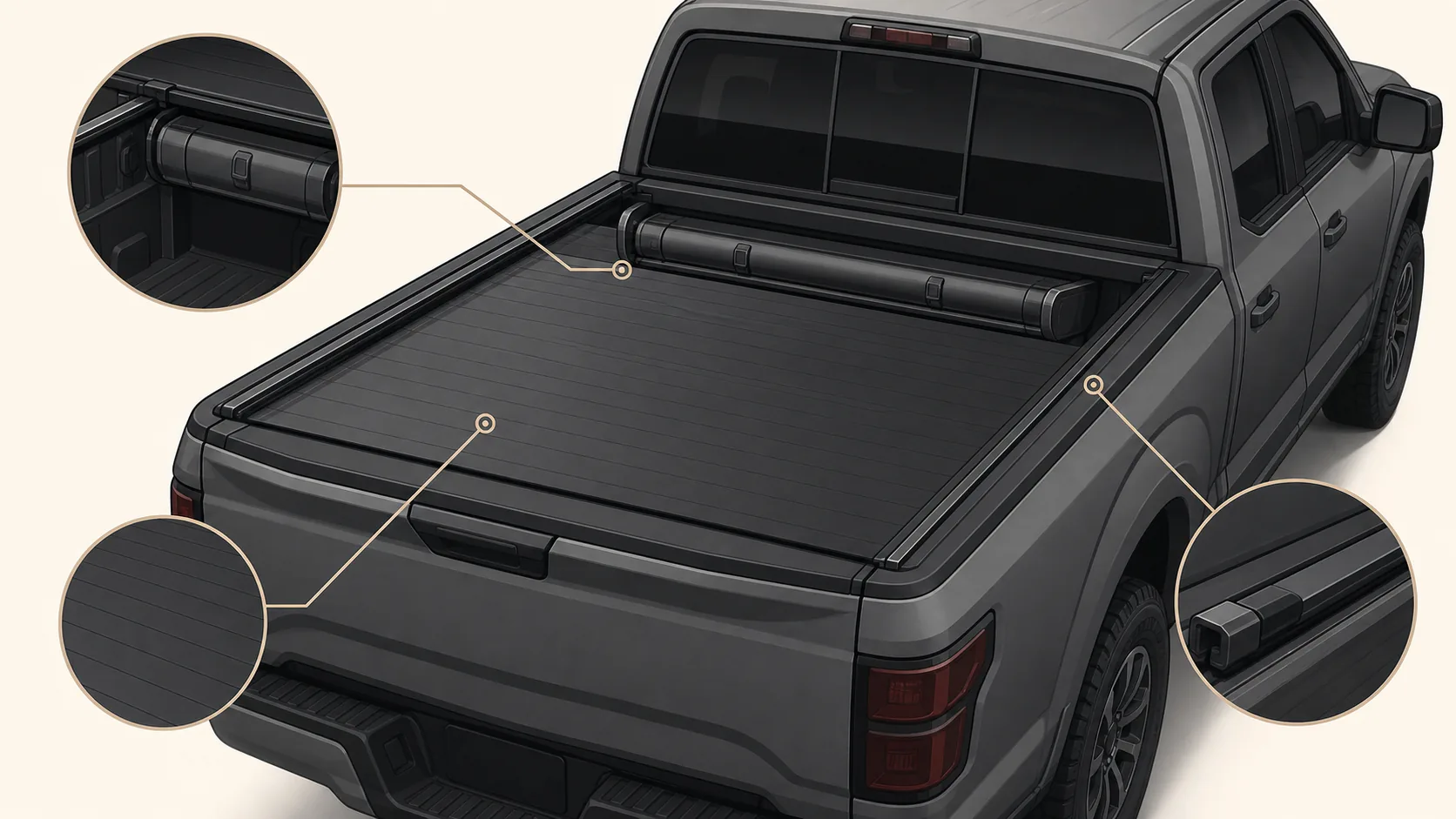
This retractable tonneau cover guide focuses on the decision points that remain after the product photos: the truck bed space used by the canister, the rails, the cover’s operation, and the exact configuration of the truck. A cover that fits a Ford F-150 with one bed length may not fit another F-150 configuration. Year, make, model, cab style, and bed length all matter.
What makes a tonneau cover retractable?
A retractable tonneau cover is a truck bed cover that moves along rails and stores into a housing at the front of the bed. That housing is commonly called a canister. The cover may use connected slats or another product-specific construction; do not assume the material or operation from the category name alone. Some products use aluminum slats, while material details should be checked on the individual listing.
The practical point is simple: a retractable design keeps the cover contained when it is open. This can suit owners who want partial bed access without handling a loose panel. It also means the canister and rails become part of the bed layout. Before installation, look at where long items, tools, or a cargo organizer normally sit.
What do you gain—and give up—with a retractable design?
The main trade-off is not “premium versus basic.” It is a choice between a contained cover system and the space that system occupies. A retractable design can offer a clean appearance and a defined operation. But the front-bed canister can matter if you routinely push long cargo all the way to the cab, carry tall equipment near the rails, or need the full bed for work.
| Question to ask | What to inspect | Why it changes the decision |
|---|---|---|
| Where does the cover go when open? | Canister position and clearance | It affects front-bed cargo space. |
| How does it move? | Manual or electric operation on the exact listing | “Retractable” does not automatically mean powered. |
| How does it close? | Documented latch or lock design and tailgate relationship | Security is product-specific, not a blanket category claim. |
| Where does water go? | Documented drainage path and installation instructions | Weather management depends on the installed system. |
| What sits above the rails? | Accessory compatibility for the exact cover | Racks and other accessories cannot be assumed to fit. |
Protection is another reason owners compare tonneau covers, but it deserves precise language. A cover may help shield the bed from weather exposure when it is correctly installed and closed. It does not make every cargo item secure in every situation. Review the product’s documented security features, confirm how the tailgate interacts with the system, and keep theft prevention separate from an appearance claim.
How should you verify retractable tonneau cover fitment?
Fitment is the key step. Truck Cover’s Fitment First process verifies a cover against five fields before shipping: year, make, model, cab style, and bed length. That is more reliable than choosing from a broad “fits F-150” label. A truck’s trim, bed configuration, rails, and accessories can affect what can be installed.
- Identify the truck’s year, make, and model.
- Confirm the cab style and the bed length.
- List existing bed accessories, including anything that uses the rails.
- Compare only covers listed for that full configuration.
- Ask for fitment confirmation before the order is finalized.
This is also the point to read the installation documentation. Installation requirements, hardware, drainage routing, and bed modifications vary by listing. If a listing does not document a compatibility detail you need, mark that detail as unverified rather than filling in the gap from a similar cover.
When is a retractable cover a sensible choice?
A retractable cover can make sense for truck owners who use the bed often but do not need its full length on every trip. The contained system can be easier to live with when the cover must open and close as part of a weekly routine. It can be less suitable when the truck regularly carries long, bulky cargo that needs the front of the bed clear.
Do not choose based on the phrase “low-profile” alone. A low-profile look describes how a closed cover sits relative to the truck bed; it does not tell you the interior clearance, the canister size, the installation work, or the accessory options. Those are individual-product questions.
If a manual system matches the way you use the truck, there is a real category to review: manual retractable tonneau covers. If the deciding factor is simply the category itself, compare only covers listed for the exact vehicle under retractable tonneau covers.
What should you compare on a product page?
Once fitment is confirmed, compare the specific cover rather than the category. Read the product page for construction material, movement, rails, canister position, lock design, water-management instructions, installation requirements, and compatible equipment. Some models document smooth movement as a product feature; where they do not, do not assume it. If the cover is described as hard, confirm what the manufacturer means by that term for that listing instead of assuming a standardized rating.
It is also useful to separate facts from recommendations. A manufacturer’s documented material or installation instruction is a fact about a listing. Whether that cover suits your use is a recommendation based on your truck, load, and routine. Keeping those two levels separate helps you choose without assuming unsupported performance or durability claims.
Before you install any cover, consider whether a fully folding or soft roll-up format would support the heavy tools you carry more naturally. This is not a universal ranking of cover types: it is a fit-and-use check. Compare the documented features, bed access, and installation requirements for the exact truck before deciding which format is appropriate.
Frequently asked questions
Do retractable tonneau covers take up bed space?
They can. A retractable system commonly stores inside a front-bed canister, and the rails also form part of the installation. The exact space impact varies by product and truck configuration. Check the product documentation and compare it with the long cargo you carry most often.
Are retractable tonneau covers powered?
Not necessarily. Retractable describes the way the cover stores and moves; operation can be manual or electric depending on the specific listing. Confirm the operation type on the product page instead of assuming it from the category name.
How do I know which retractable cover fits my truck?
Verify year, make, model, cab style, and bed length, then account for installed accessories. Truck Cover checks these fitment fields before shipping. If an accessory or configuration is not documented, ask before ordering.
Next step: match the cover to the truck
Use the exact truck configuration to narrow the list, then compare the canister, rails, operation, installation, and cargo clearance on the remaining covers. That is the useful order: fit first, cargo routine second, product features last.
Sources and scope
- Truck Cover brand playbook: Fitment First verification by year, make, model, cab style, and bed length.
- Truck Cover retractable tonneau cover category, checked July 2026.
- This guide does not state model-specific prices, dimensions, warranties, payloads, or weather/security performance because those details must be verified on each product page.


